


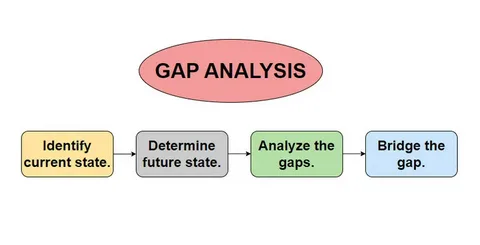
In the rapidly evolving business landscape, understanding where your organization stands relative to its potential is critical. A business gap analysis serves as a strategic compass, helping companies identify performance gaps between their current state and desired objectives. Whether you are a startup seeking market positioning or an established enterprise navigating competitive pressures, conducting a thorough business gap analysis reveals untapped opportunities that drive measurable growth.
Business gap analysis empowers businesses to make informed decisions, optimize resource allocation, and identify market opportunities competitors might overlook. By systematically examining performance gaps across operations and market positioning, organizations develop actionable roadmaps bridging the divide between current state and strategic vision.
What is Business Gap Analysis and Why does It Matter?
Business gap analysis is a systematic process measuring the difference between an organization’s current performance and its desired future state. This analytical approach compares actual outcomes with industry benchmarks and competitor performance to highlight improvement areas.
Conducting a business gap analysis identifies market gaps where customer needs to remain unmet or underserved. By recognizing these gaps, businesses create sustainable competitive advantages and differentiate themselves in crowded markets.
Key benefits of business gap analysis include:
- Strategic clarity: Establishes clear vision between current and desired states
- Resource optimization: Directs investments toward high-impact improvement areas
- Risk mitigation: Identifies potential threats before they escalate
- Performance improvement: Reveals specific metrics requiring attention
- Competitive advantage: Spots market opportunities competitors haven’t addressed
Types of Business Gap Analysis Organizations Should Conduct
Organizations face multiple dimensions requiring business gap analysis for comprehensive organizational evaluation.
Performance Gap Analysis measures company goals against actual results, identifying necessary changes to operations, finances, and customer satisfaction metrics.
Market Opportunity Gap Analysis focuses on identifying unmet customer needs and underserved segments, revealing profitable white space opportunities for innovation and growth.
Competitive Positioning Gap Analysis compares your organization’s performance against direct competitors, evaluating product features, pricing, marketing effectiveness, and service quality.
Digital Transformation Gap Analysis assesses your digital maturity against industry standards. With 75% of executives struggling with digital maturity gaps, this analysis reveals technology readiness.
Operational Efficiency Gap Analysis identifies process inefficiencies, resource allocation gaps, and workflow bottlenecks affecting profitability.
Key analysis components to include:
- SWOT assessment: Evaluate strengths, weaknesses, opportunities, and threats systematically
- Benchmarking: Compare performance against industry standards and best practices
- Stakeholder interviews: Gather insights from leadership, teams, and customers
- Data analytics: Analyze historical patterns and performance metrics comprehensively
- Competitor research: Study competitor offerings, positioning, and market strategies
How to Identify Market Gaps and Unmet Customer Needs?
Identifying market gaps requires strategic market research combining qualitative and quantitative methodologies. Successful companies recognize that market gaps represent differentiation and revenue opportunities.
Practical techniques for identifying market gaps:
- Google Trends analysis: Track emerging search patterns and shifting customer interests
- Customer interviews: Conduct in-depth conversations with target audience members
- Online community monitoring: Analyze discussions in forums and niche communities
- Survey data collection: Gather structured feedback on pain points and desired solutions
- Social listening: Monitor conversations identifying emerging needs and market trends
Conducting Your Business Gap Analysis: A Strategic Framework
Executing effective business gap analysis requires systematic methodology and cross-functional collaboration, ensuring comprehensive evaluation and actionable insights.
Step 1: Define Current State — Establish accurate baseline measurements across operations, finances, customer satisfaction, and market positioning through data collection.
Step 2: Define Desired Future State — Articulate clear, measurable objectives aligned with strategic vision through leadership and stakeholder engagement.
Step 3: Identify Performance Gaps — Compare current metrics against desired targets using benchmarking to assess performance against industry standards.
Step 4: Analyze Root Causes — Investigate why gaps exist by examining internal factors (resources, processes, capabilities) and external factors (market dynamics, competitive actions).
Step 5: Develop Action Plans — Create strategic initiatives addressing highest-impact gaps with specific actions, timelines, resources, metrics, and accountability assignments.
Essential gap analysis framework components:
- Data collection methods: Surveys, interviews, analytics, and benchmarking reports
- Stakeholder engagement: Leadership alignment and cross-functional input gathering
- Benchmark research: Industry standard comparison and competitor analysis
- Metric definition: Clear KPIs measuring gap closure progress and success
- Implementation roadmap: Phased approach with milestones and resource allocation
Leveraging Business Gap Analysis for Strategic Growth
Strategic growth requires translating gap analysis insights into concrete initiatives. Organizations effectively acting on gap analysis findings report significantly higher growth rates.
Businesses conducting regular gap analyses grow organic traffic by 33%, compared to 10% for those neglecting this analysis. This reflects the comprehensive impact of data-driven strategic decision-making across business functions.
Market gap analysis drives innovation by revealing customer needs that existing solutions don’t adequately address. Companies identifying market gaps early gain first-mover advantages and establish market positions before competitors recognize opportunities.
Competitive gap analysis informs positioning strategies differentiating offerings in crowded markets. Understanding competitor strengths and weaknesses enables strategic positioning as superior alternatives addressing underserved needs.
Strategic implementation of gap analysis insights:
- Innovation pipeline: Develop products addressing identified market gaps
- Service enhancements: Improve offerings to close competitive positioning gaps
- Process improvement: Optimize operations addressing operational efficiency gaps
- Digital capabilities: Invest in technology addressing digital transformation gaps
- Market expansion: Target underserved segments identified through market analysis
DigiFlute: Your Strategic Gap Analysis Partner
Conducting comprehensive business gap analysis requires specialized expertise and proven methodologies. DigiFlute Media Labs specializes in delivering strategic gap analysis solutions, transforming insights into measurable growth.
DigiFlute combines deep strategic consulting expertise with advanced analytics capabilities. Our proven gap analysis methodology has helped 500+ businesses across 20+ industries identify critical performance gaps and develop actionable roadmaps.
DigiFlute’s comprehensive approach includes:
- Strategic Performance Gap Analysis: Evaluate performance against benchmarks using advanced analytics
- Market Opportunity Gap Analysis: Discover untapped segments and unmet customer needs
- Digital Transformation Gap Analysis: Assess digital maturity and innovation readiness
- Operational Efficiency Gap Analysis: Identify process inefficiencies and optimization opportunities
- Competitive Positioning Gap Analysis: Understand market position and differentiation opportunities
Conclusion
Business gap analysis represents a strategic imperative in today’s competitive landscape. By systematically identifying performance gaps, market opportunities, and positioning weaknesses, organizations unlock pathways to sustainable growth and competitive advantage.
Thriving businesses recognize that gaps represent opportunities rather than obstacles. Whether navigating digital transformation, identifying market opportunities, or optimizing efficiency, comprehensive business gap analysis provides strategic clarity for informed decision-making and sustainable success.
Ready to transform performance gaps into competitive advantages? Visit DigiFlute to schedule a free consultation with our gap analysis experts. Discover how our data-driven approach unlocks hidden opportunities, closes critical performance gaps, and drives measurable business growth.
