


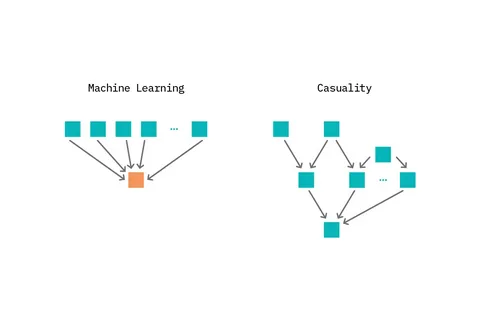
The world of data science has long been enamoured with patterns. When one variable rises and another follows, it’s tempting to declare one as the cause of the other. Yet, this seductive link between correlation and causation often leads analysts astray. In the real world, relationships between variables unfold across time, shaped by sequences, delays, and dependencies. Understanding why something happens — not just when — is where temporal causality reshapes the landscape of modern data science.
As industries increasingly rely on predictive algorithms to make crucial decisions, merely identifying associations is no longer enough. Today, the frontier lies in unravelling causal relationships embedded in time-dependent data — a shift from passive observation to active explanation.
The Limitations of Correlation
Correlation, though foundational, offers only a shallow view. It tells us that two variables move together, but not whether one influences the other. For instance, a spike in ice cream sales might coincide with an increase in drowning incidents, but the underlying factor is the temperature rise — not a direct cause-and-effect link between the two.
In domains like finance, healthcare, and climate science, acting on mere correlations can be misleading. Stock prices might rise after a policy announcement, but was it the announcement or prior speculation that triggered the movement? Without temporal understanding, it’s impossible to distinguish sequence from coincidence.
Temporal causality steps in to address this gap. By focusing on how events influence one another over time, models can infer directionality and delay, identifying not only whether one variable affects another but also when and how strongly it does.
What Temporal Causality Really Means
Temporal causality is the study of cause-and-effect relationships within a timeline. It assumes that causes precede effects and that time series data holds valuable clues about these dynamics. One of the pioneering approaches to this problem is Granger causality, introduced by economist Clive Granger, who proposed that if a signal X helps predict another signal Y beyond what Y’s past can expect, then X can be said to Granger-cause Y.
Although elegant, Granger causality has its limitations — it assumes linearity and may struggle with complex, non-linear data. Modern approaches, such as Transfer Entropy, Convergent Cross Mapping (CCM), and neural-based causal discovery methods, extend these ideas to capture richer, more intricate temporal dependencies.
The real breakthrough lies in combining statistical reasoning with machine learning architectures. Deep temporal models, such as Temporal Convolutional Networks (TCNs) and Transformer-based causal inference systems, are now capable of learning latent causal structures from massive datasets, enabling data scientists to decode complex interactions that evolve.
Real-World Examples of Temporal Causality
The power of temporal causality is best understood through real-world scenarios. In healthcare, for example, understanding the causal chain between medication intake and changes in heart rate can help clinicians anticipate side effects before they become dangerous. Similarly, in climate modelling, scientists can study how variations in ocean temperature precede and influence atmospheric patterns, such as El Niño, rather than merely observing correlations.
In marketing analytics, time plays a critical role in attribution modelling. Instead of assuming that the last click before purchase deserves all the credit, causal models can uncover how earlier touchpoints — such as a social media ad or a newsletter — contributed to the final decision. Temporal causality brings depth to customer journey analysis, providing insights that drive smarter budget allocation.
For students and professionals exploring this space, advanced training such as a data science course in Bangalore can help in understanding how to apply causal inference methods to diverse time-based datasets. Knowing how to build models that reflect temporal logic rather than static snapshots is rapidly becoming a defining skill in data-driven roles.
The Tools and Techniques Behind Temporal Analysis
Modern toolkits now make it easier to apply temporal causality principles in practice. Libraries such as Tigramite, CausalNex, and DoWhy enable analysts to perform causal discovery and inference within time series frameworks.
Researchers often begin by testing for Granger causality to identify directional dependencies. However, when dealing with non-linear or high-dimensional data, deep learning models provide the flexibility to model hidden temporal layers. These methods are especially useful in sensor analytics, financial forecasting, and operational monitoring, where causal patterns evolve dynamically.
A notable advancement is Temporal Graph Neural Networks (TGNNs), which capture the evolution of entities and their relationships over time. Such models are increasingly used in traffic forecasting and fraud detection — areas where understanding causal progression is crucial for intervention and prevention.
Beyond Prediction: Towards Explanation
The transition from correlation to causality also represents a philosophical shift in how we use data. Predictive accuracy, once the gold standard, is no longer the only measure of success. Organisations now demand interpretability — the ability to explain why an algorithm made a particular prediction.
Temporal causality bridges this gap by introducing time-based reasoning into AI decision systems. Rather than treating data as static inputs, it frames them as evolving stories. This approach not only enhances trust in AI systems but also enables proactive decision-making. For example, a bank could use temporal causal models to understand how specific customer behaviours lead to credit risk, allowing intervention before default occurs.
The growing relevance of these techniques has made temporal reasoning a vital part of the modern data science curriculum. Professionals pursuing a data science course in Bangalore are now exposed to modules on causal inference, time-series forecasting, and explainable AI — skills that prepare them to handle real-world complexities beyond linear associations.
The Road Ahead
As AI systems increasingly shape critical sectors — from healthcare to finance — the demand for causally aware intelligence will rise. Future data scientists will need to design models that understand the temporal order of events and their underlying interconnections, enabling true insight rather than surface-level prediction.
With the integration of causal inference and temporal analytics, we are moving closer to systems that can reason like humans — understanding not just what happened, but why it did, and what is likely to happen next.
Conclusion
Temporal causality marks a defining evolution in data science. It moves the field from correlation-hunting to cause-seeking, from observation to explanation. By embedding time into the heart of analysis, it helps data scientists capture the unfolding rhythm of cause and effect that drives real-world phenomena. In the years ahead, those who master temporal thinking will not just predict the future — they will understand it.
