


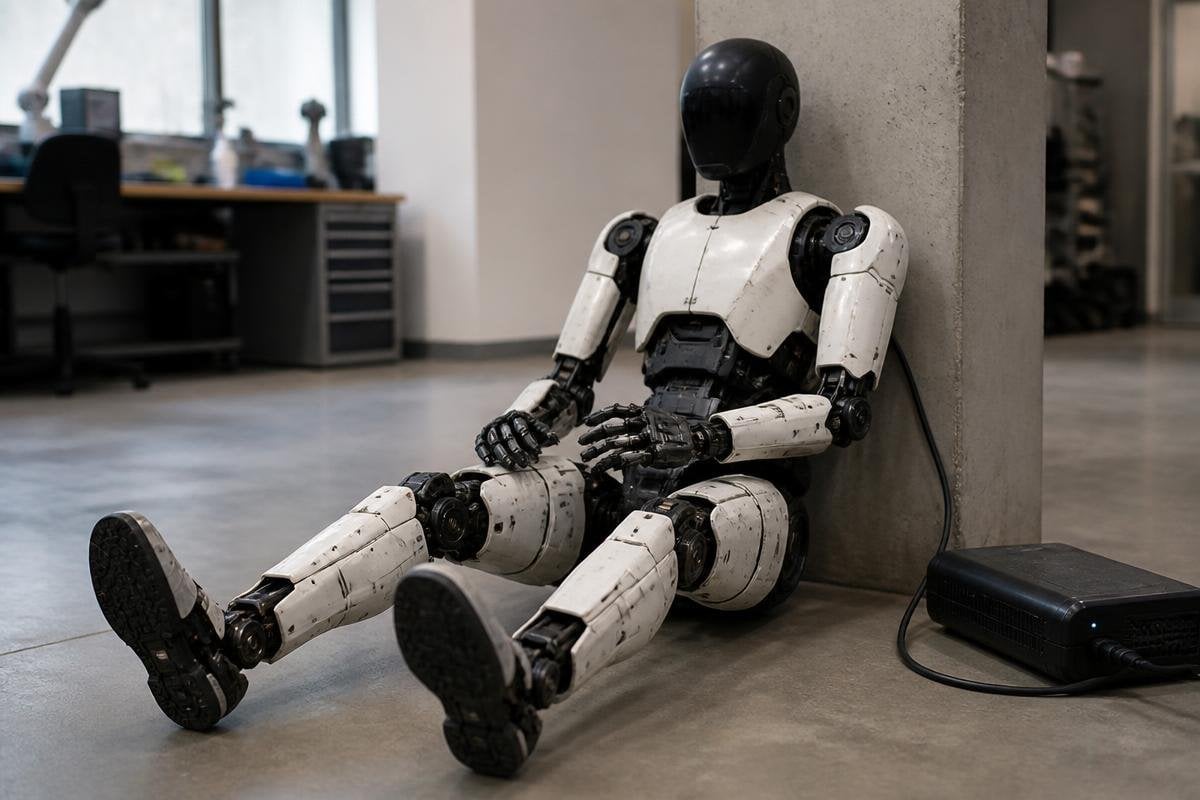
A humanoid robot can have working hands and steady legs, then stop because its battery cannot carry enough energy for a long task. For robots meant to work around people, battery design affects walking time, lifting strength, heat, charging, and safety.
- Battery mass reduces the payload left for tools or goods
- Motors, sensors, and onboard computers all draw power
- Fast charging adds heat and can shorten battery life
Why the battery takes so much space
A humanoid robot spends energy on every step. Its motors must lift parts of its own body, correct balance, move the arms, and keep sensors running.
A wheeled robot can roll with little change in height, while a walking robot keeps moving its mass up and down. That demand leaves less energy for useful work.
If engineers add more battery cells, the robot gets heavier. The extra mass then makes each step cost more energy, so the added battery does not translate into the same amount of extra working time.
The battery also competes with the payload. A robot carrying a larger battery may have less room for a tool, package, or gripper load. That trade affects factories, warehouses, and service sites where the robot must earn its power use by doing a task.
Heat is part of the battery problem
Power does not leave the battery as motion alone. Some of it becomes heat in the cells, motor drivers, actuators, and computers. A battery management system checks cell voltage and temperature, then limits current when conditions become unsafe.
Those limits can change what the robot does. A robot may lift well at the start of a task, then reduce speed or stop after repeated walking and lifting have warmed the system. Cooling hardware can lower that risk, but fans, pumps, heat sinks, and ducts add mass and use more power.
Fast charging creates the same trade. It cuts the time spent beside a charger, yet high charging current raises heat and can speed battery wear. A useful robot needs a charging plan that fits its work cycle, rather than a large peak charging figure on a product sheet.
Battery weight affects every step a humanoid takes. Reporting on cells, charging tests, and robot trials can show whether a claimed gain survives a full work cycle. Robot24.com puts those machines and companies in view before the battery targets below.
What better batteries must do
Lithium-ion cells are common because they store much energy for their mass, but they still force engineers to choose between weight, runtime, heat, cost, and service life. A better pack would need gains across the whole system, not a single larger cell.
The pack needs high energy density so the robot can work longer without carrying a heavy block. It also needs enough power output for short bursts when the robot rises, catches its balance, or lifts a load. Energy stored and power delivered are related, but they are not the same battery measure.
Regenerative braking may return some energy when joints slow down. That helps in tasks with repeated motion, though it cannot recover all the energy spent lifting the robot or holding a load. Control software, motor design, and battery chemistry still have to work together.
Service matters too. A swappable pack could keep one robot working while another pack charges. That adds handling equipment and spare battery cost, and the swap must be safe around high-current connectors. A fixed pack may save space but can keep the robot out of service during charging.
A buying check for work trials
Before you judge a humanoid robot for a site, check these points:
- Task runtime: Ask how long the robot performs the planned task, not how long it stays powered on.
- Load at runtime: Check payload while walking, reaching, and turning, since those actions draw more power than standing.
- Charge plan: Confirm charge time, connector safety, spare packs, and the number of robots sharing a charger.
- Heat limits: Ask when the robot slows, pauses, or stops after repeated work.
- Battery service: Check replacement cost, expected cycle life, and who can change the pack.
The strongest opposing view is that better software and lighter mechanics may cut battery demand without a new cell chemistry. That is right, and it may produce faster gains than waiting for a major chemistry change.
I’d wait for task-level runtime data before paying for a humanoid robot whose battery figures cover standing, walking, and charging as separate tests. Until makers report hours of repeated work with a stated load and recovery time, battery design remains the limit that decides whether the robot works a shift or returns to its charger.
